Thursday, July 19, 2012

Revealing Infographic on the TSA

There are more and better reasons to abolish the TSA--reasons having to do with the gross injustice of its actions--but this is a good compilation of facts showing the uselessness of much of what its agents do and the huge amount of money the TSA takes (from taxpayers) to do it:


Image Source: Hardwood Flooring Baltimore

Monday, July 16, 2012

The Entire Biography of Steve Jobs in 3 Short Quotes


Walter Isaacson's biography of Steve Jobs is 656 pages long, but  these three quotes (not included in it) sum up a huge portion of what Isaacson wrote:

1. "He's not the Messiah, he's a very naughty boy!"

This quote comes from Brian's mother in The Life of Brian and, while Jobs's god-like status in business is definitely earned, so too was his status (for a time) as a trouble-making kid.

2. "Do whatever you do intensely." 

This quote comes from Robert Henri and advises something that Isaacson repeatedly shows Jobs put into practice.

3. "All he asked of life was the best of everything."

This quote comes from the daughter of the Italian inventor, Guglielmo Marconi, and is about her father's desire to have nothing less than the best; it also, however, applies to Jobs—as readers of Isaacson's biography will see in spades.

Of course, it should go without saying that these three quotes leave out a ton of details. For those, you can start by reading my review of the book, an article I wrote that contains excerpts from it, or skip all that and dig in to the biography itself. 

Wednesday, July 11, 2012

A Successful Kid

Many parents say they want a successful kid, but what exactly does a successful kid mean?

On one level, I think it means something different for each kid, according to what they value--what they want to have and do.

On another level, it can and I imagine almost always means something similar. For example, in spite of different values, kids want to have their feelings, all of their feelings, acknowledged. That, to them, is a successful outcome (and it should be for parents too).

On still another level, a successful kid is one who has gained important values, such as self-esteem, or skills, such as the ability to solve problems and arguments with others.

I had all of this in mind recently, having just finished reading two books by Adele Faber and Elaine Mazlish (called Siblings Without Rivalry and How to Talk So Kids Will Listen and Listen So Kids Will Talk).

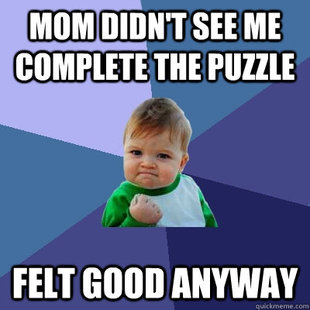
Then I learned that I could easily make memes for some of the outcomes that they show parents helping to make possible. So, guess what? That's what I did. And here they are:


 Now this, to my mind, is a successful kid! 


He has his feelings acknowledged, he has learned problem-solving skills, and he knows how to take pride in his own achievements rather than look for approval from anyone else.

What do you think?

You can make other memes like the above here.
It's super-simple. Or, if you're interested in a review of a book on parenting, specifically one of those mentioned above, you may want to read this review of How to Talk So Kids Will Listen and Listen So Kids Will Talk..

Your kid will thank you for it (although it may take him 20 years to do so).

Thursday, July 5, 2012

A Book for Our Epically-Challenged Times


If you agree with me about the value of epics, and have decided to experience an inspiring epic for yourself, one book to check out is Atlas Shrugged.

Published in 1957, and written by Ayn Rand, Atlas Shrugged is a novel of epic scope. Its style, like epics of the past, is similarly elevated in terms of the language it uses and the symbols it employs.

Should you open the book up, however, you will not read of a world where Dawn’s “rose-red fingers” blaze across the sky; Ayn Rand’s fiction, like the reality we live in, is a world where humans and specifically that which makes them human—their minds—create everything of value.

This role of the mind is actually the theme of the novel, and it’s expressed in part via two of the book's main story lines: the struggle of Dagny Taggart to keep a transcontinental railroad profitable in spite of ever more shackles put on it by the government and of Hank Rearden to discover a new type of metal and then to produce it while the men he pays and the material he owns by right are increasingly controlled by Washington bureaucrats.

The theme is also expressed via the struggle of one man to show the world who relies on whom, and what all the things that keep men alive depend on. He will show it by taking it away, leaving men free to see what happens in a world where those who use their minds are absent. And then he will advise them what to do, saying, in part, to those who want to live:

In the name of the values that keep you alive, do not let your vision of man be distorted by the ugly, the cowardly, the mindless in those who have never achieved his title. Do not lose your knowledge that man's proper estate is an upright posture, an intransigent mind and a step that travels unlimited roads. Do not let your fire go out, spark by irreplaceable spark, in the hopeless swamps of the approximate, the not-quite, the not-yet, the not-at-all. Do not let the hero in your soul perish, in lonely frustration for the life you deserved, but have never been able to reach. Check your road and the nature of your battle. The world you desired can be won, it exists, it is real, it is possible, it's yours.

Atlas Shrugged is not the only modern epic that offers inspiration to those who need it. Others, such as James Clavell’s Asian Saga, Ken Follett’s The World Without End, or the Korean TV series Dae Jang Geum, do the same--showing virtuous characters facing enormous challenges, over decades, and winning.

But in combining the epic story with the specific message to fight for your values, and the knowledge that this is the right thing to do, Atlas is one book for our epically- (let alone ethically-) challenged times.

Whether you choose to read Atlas, or watch Dae Jang Geum, or dive into the awesomeness of James Clavell's Shogun, however, I highly recommend finding some epic, one that you can enjoy and one that inspires to make your life better. 

Tuesday, July 3, 2012

The Value of Epics for the Epically-Challenged


“Epic” is one of the most misused words today. It is also one of the most overused.

People use it to describe a clever retort. They use it to describe a nap. They use it to describe a trick. And they use it to describe a pizza. In fact, if someone evaluates anything positively now, it seems that he will invariably declare it “epic.”

But this is nonsense, and hopefully a passing linguistic error.

Despite its misuse, the word “epic” has a legitimate and easily graspable meaning. As an adjective, it means “heroic or grand in scale or character” and, as a noun, it indicates “a long film, book, or other work portraying heroic deeds and adventures.”

It is ironic that in a world where so little can be called epic—according to the word’s actual meaning—so much mistakenly is. It is also a bad omen, because whether struggling to gain more money, to achieve happiness, or to live in a free society, everyone today faces huge challenges and could get much out of a true epic.

Without the experience of reading great literature or great movies, and especially epics within them, what will people do? Chances are they will fight for their values to some extent, no matter what they are, but not with the burning passion or with the persistence that winning them requires.

Epics, as works of art, have particular features that allow those who read them to act otherwise, to approach their life, and the pursuit of their values, with vigor.

The style of epics, for one, is notably grand in its use of language, symbols, and descriptions. In The Iliad, you don’t just see the sun come up or—Zeus forbid—watch it mosey across the sky; rather, you see the “rose-red fingers” of Dawn shine across it. Characters, such as Achilles, are not statistical composites of your neighbors; they are high-hearted, mighty, like unto the gods. And so on.

There is something uniquely un-folksy about the epic style, and examples abound. Stated positively, however, the language is of a world that might have huge forces arraigned against its heroes but seems a place that offers them the chance of sacred moments and of a success to be earned.

This should not be surprising for it matches the content of epics—that is, the grand style is consistent with the story it tells of specific kinds of characters who face huge challenges.

For example, Odysseus, the hero of The Odyssey, must battle gods and men, as well as his own desires, and do so successfully, across decades, before reaching his goal and returning home to his wife, Penelope. Likewise, in Beowulf, the hero must battle against huge beasts, using the sword of past giants to defeat one.

No matter the epic, however, in terms of both content and style, they are grander in a way than everyday life.

But so what—what is useful about viewing someone who overcomes such odds or even just battles admirably against them? Seeing someone tackle immense obstacles, gives readers a useful perspective for viewing their own challenges. And, in seeing heroes overcome those huge obstacles, readers can better tackle their own, smaller ones with passionately-driven tenacity.

The more difficult question to answer is this: In a world where so many people point to so many things as epic, where can one discover the true epics, those that deliver on the above promise?

(Click here for my answer.)

Tuesday, June 12, 2012

50 Shades of Graphite

So, you've read how I started drawing again, how that drawing thing is going, and even my most recent post on starting to like the smell of graphite in the morning.

But you've been asking your good-looking self a question:

"What has Daniel been drawing lately?"

Daniel, that's me for those who don't know, has actually not been drawing a lot lately. Or rather, I've been drawing some profiles, but nothing I want to share here.

Excepting that is for this:


This is from a painting by Odysseas Oikonomoy. I rather like it. And I hope you enjoy it--it may be the last copy of someone else's work that I do for a while, or ever.

(More on that last bit later...)


Update: 

There are four posts on this same topic now. If you're interested in reading them all, check out the following links.

1. How I Started Drawing Again
2. How That Drawing Thing is Going
3. I'm Starting to Like the Smell of Graphite in the Morning
4. 50 Shades of Graphite

Friday, June 8, 2012

3 Quotes on Raising a Brighter Child Translated for Stupid Parents


How to Raise a Brighter Child is one of my favorite books on parenting, mostly because it shares so many useful tips toward the goal of raising smarter kids.

When initially writing this post, for another blog, I was going to give a sampling of those tips via a selection of relevant quotes. However, about halfway through, I decided to shelve that idea and have a little fun instead.

Here, then, are three quotes on raising a brighter child translated for "stupid" parents:
1. "The force of gravity is the one constant point around which a baby systematizes all the spatial relationships he is working out for himself during his early sensorimotor stage of life."
This means that your kid’s going to throw a lot of stuff. Try not to stress out about it.
2. “In talking to their offspring, [effective] parents ‘consider the baby’s purpose of the moment’ and .  . . ‘do not prolong the exchange longer than the baby wants.’”
This means that when your kid asks what time it is, don’t respond with a lecture on the history of clocks or how they’re made.
3. “Give your preschooler the courtesy of listening to her with as much regard and attention as you’d give an adult guest in your home.”
This means that you should treat your kid as if you invited her into your house. After all, in choosing to have and care for a child at all, you kind of did.

I wanted to translate even more than this, but the book is notably absent of gobbledygook; the above three being the closest it comes to being complex.

Have you read it yet? What did you think?